
Responsible Gambling Tools in Canadian Online Casinos: A Full Overview

Responsible gambling tools are the mechanisms a regulated operator must build into its platform so a player can cap what they spend, cap how long they play, or stop entirely. In Canada, what you get depends on where you live. Ontario runs a competitive market with several licensed operators, and its tools are centralized through iGaming Ontario. Every other province runs a single site through its lottery corporation, and the tools sit inside that one product.
If you are still working out which market you are playing in, this overview of playing online in Canada sets out the provincial picture before you commit to a site. This article covers what each mechanism actually does, which regulator or program stands behind it, and what it costs you in money or time to use it.
What Responsible Gambling Means in a Regulated Market
The phrase gets used loosely. In a regulated market it has a narrower meaning. It describes a set of controls that a player can switch on, that the operator cannot quietly switch off, and that a third party audits.
The Responsible Gambling Council (RGC) supplies the clearest working definition through the resources iGaming Ontario links from its own responsible-gambling page. Three of them matter here.
- A self-assessment quiz, framed as a way to check in on your gambling. It isn’t framed as a diagnostic test, and nothing suggests it produces a pass/fail score. It asks you to look at your own behaviour and decide whether it matches what you intended.
- Cost2Play, which estimates what gambling actually costs a player over time. That framing is the useful part. A deposit limit tells you what you are allowed to put in. Cost2Play tells you what has already gone out, accumulated across sessions, which is the number most players never add up.
- RG Check, an accreditation that Ontario-registered operators must achieve and maintain to keep operating. That is the structural piece. It converts responsible gambling from a marketing claim into a condition of holding a licence in the province.
The Core Tools and What Each One Does
Six mechanisms show up across regulated Canadian operators. They differ in what they restrict and in how hard they are to reverse.
Deposit Limits
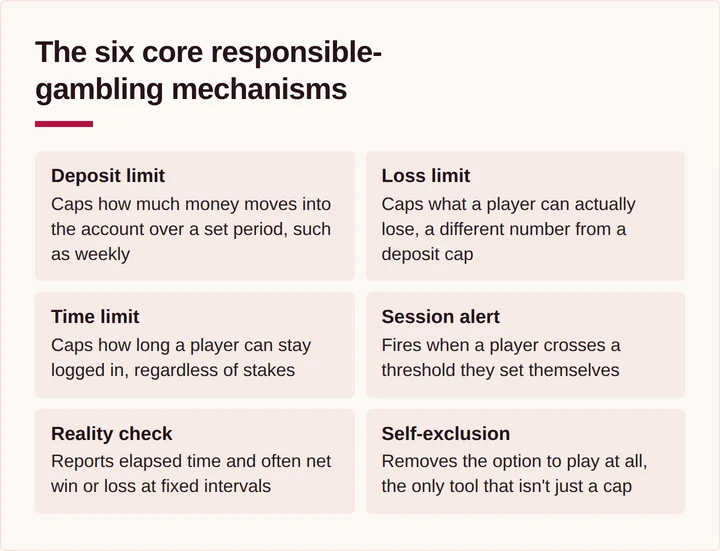
A deposit limit caps how much money you can move into your account over a set period. PlayNow, the British Columbia site run by BCLC, publishes its own example of the shape this takes. That example is a weekly deposit. The period is the part that matters. A weekly cap and a monthly cap restrict very different behaviour, and a cap you can lower instantly but raise only after a waiting period is a different tool from one you can adjust freely in both directions.
Loss Limits
A loss limit caps what you can lose. The distinction is real. Money deposited and then withdrawn again was never lost, so a deposit cap alone does not bound your downside. Availability of loss limits varies by operator, and where they exist the mechanics vary too, so check the specific terms on the site you use.
Time and Session Limits
A time limit caps how long you can stay logged in. It is the only one of these tools that restricts a resource other than money. Session length is a poor proxy for harm on its own, since a long session at low stakes and a short session at high stakes are not equivalent, but it is the mechanism that catches the player who has lost track of the clock.
Session Alerts and Reality Checks
Session alerts and reality checks interrupt play to tell you something. A reality check typically reports elapsed time, and often net win or loss, at fixed intervals. A session alert fires when you cross a threshold you set. Both are informational and neither restricts you. They do not stop you, and they remove the excuse that you did not notice. Their value depends entirely on whether you act on the interruption.
Self-Exclusion
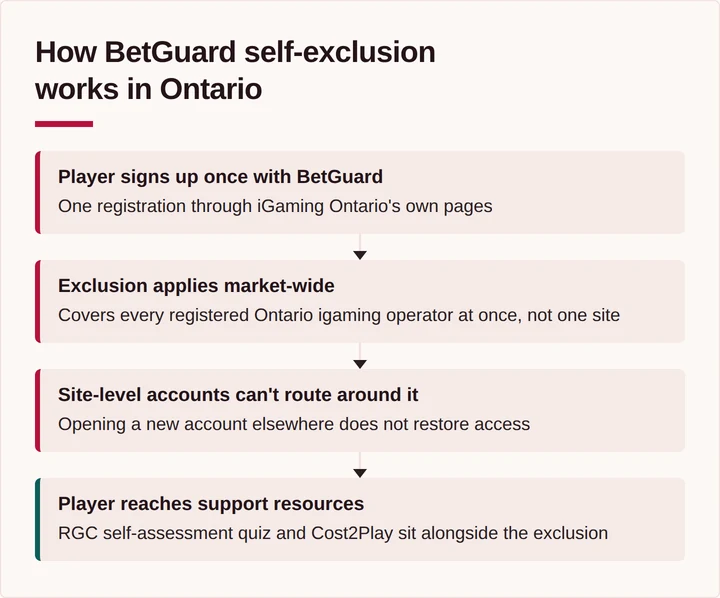
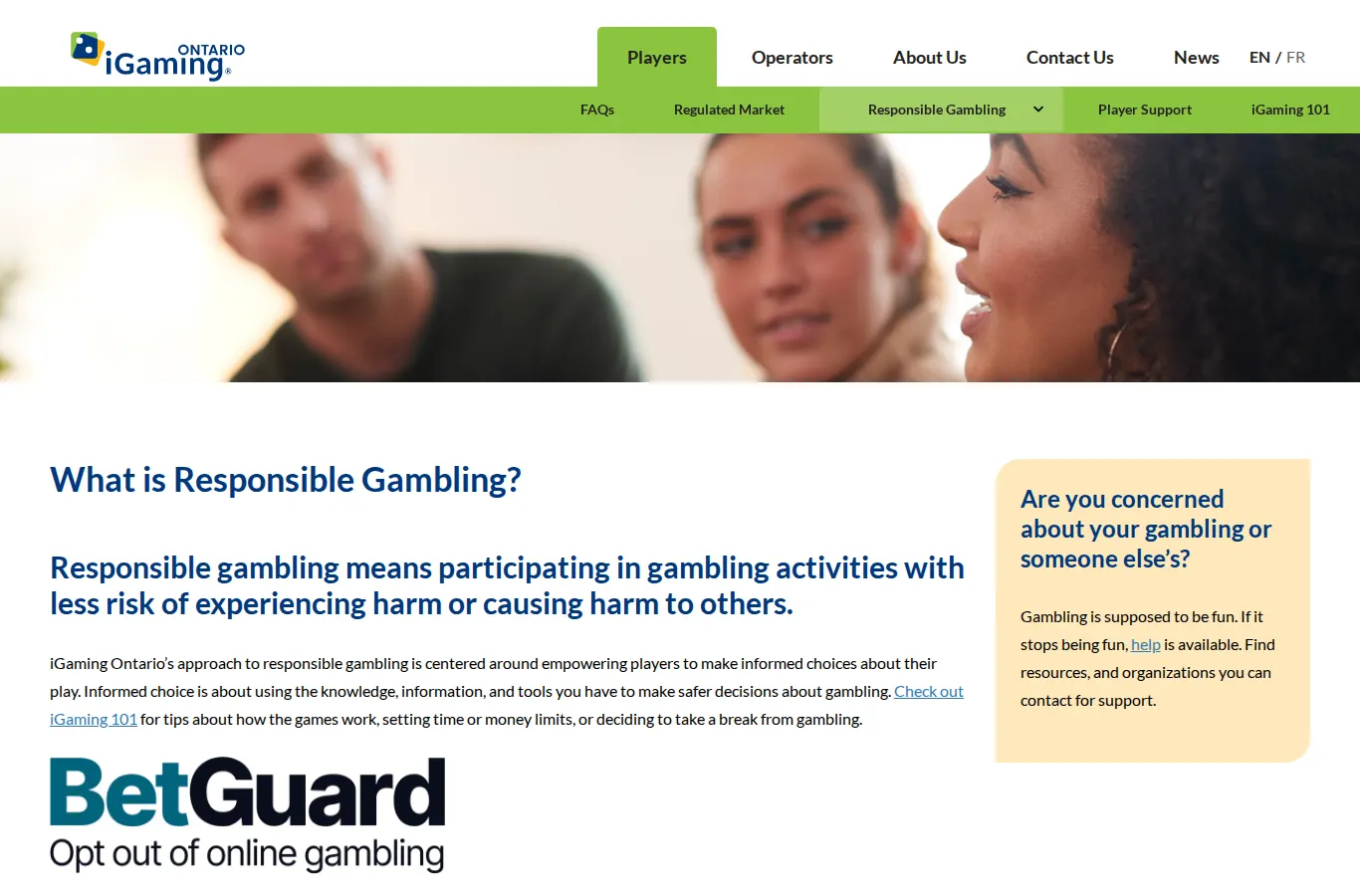
Self-exclusion is the hard stop. In Ontario it is centralized. BetGuard is iGaming Ontario’s single-signup self-exclusion tool, and one signup opts a player out of every registered Ontario igaming operator at once. That centralization is the whole point. A site-level exclusion is easy to route around by opening an account somewhere else, and BetGuard closes that route across the provincial market in one step. iGaming Ontario separately warns players about impostor and lookalike BetGuard sites, so if you are signing up for self-exclusion, reach it through iGaming Ontario’s own pages. A third-party site offering the same service is not the service.
In British Columbia, the equivalent has a different name. Game Break is PlayNow’s self-exclusion program, presented as a way to take a break and regain control. Same function, single-operator scope, because BCLC runs the only regulated site in the province.
Cooling-Off Periods
A cooling-off period is a shorter, softer version of exclusion. It suspends your account for a defined window without the full commitment of a self-exclusion registration. Operators set their own terms here, and the length and the reversibility differ, so read the specific policy before you rely on it.
Where the Tools Come From: Ontario Versus the Rest of Canada
Ontario is the outlier. It runs Canada’s only competitive, multi-operator regulated online gambling market, overseen jointly by iGaming Ontario and the AGCO. BetGuard sits with iGO because iGO runs the centralized side of the market.
Every other province runs a single-operator model instead. The provincial lottery corporation operates the site, and there is no competing licensed product to move to. British Columbia is the concrete case. PlayNow is operated by BCLC and restricted to BC residents. Its toolset is published in one place because there is one operator to publish it. Deposit limits, Game Break, and GameSense, BCLC’s responsible-gambling education brand, all sit under the same roof.
| Province | Operator model | Self-exclusion program | Helpline |
| Ontario | Multi-operator, run through iGaming Ontario + AGCO | BetGuard (covers every registered operator at once) | — (no centralized number confirmed) |
| British Columbia | Single-operator, BCLC’s PlayNow | Game Break | 1-800-463-1554 |
That difference changes what a tool can do. A centralized self-exclusion like BetGuard only works because there is a market with many operators to exclude you from. In a single-operator province, excluding yourself from the one site is the whole of the available action, and the practical question becomes whether the provincial regulator offers anything beyond it.
Quebec illustrates how these structures shift over time. The province’s old standalone Espacejeux consumer brand now redirects into the general Loto-Québec portal, so it no longer operates as a separate consumer-facing brand. If you are comparing provinces, compare the current structure.
How to Use These Tools Effectively
Set limits before you need them. A deposit limit configured during a losing session is a limit set by the version of you that wants to keep playing.
Pick the mechanism that matches the problem. If money leaves your account faster than you intend, a deposit limit or loss limit addresses that directly. If the issue is duration, a time limit or reality check is the right tool. If you cannot stop at all, self-exclusion is the only one of these that removes the option entirely.
Use the RGC self-assessment before you decide. It costs a few minutes and it gives you something concrete to act on, which is more than most players have when they first think about setting a limit.
Run Cost2Play if you are unsure whether there is a problem. The tool estimates what gambling costs you over time, which is the figure that tends to settle the question.
Treat the helpline as a tool you can use anytime. PlayNow publishes a problem-gambling helpline at 1-800-463-1554.
For BetGuard, sign up through iGaming Ontario.
Additional Support for Players
The RGC resources reachable from iGaming Ontario’s responsible-gambling page cover the self-assessment quiz, Cost2Play, and RG Check. Two of these are for players; the accreditation is for operators, and its practical value to you is indirect. It is the reason a licensed Ontario operator has to maintain these tools as a standing requirement.
BCLC’s GameSense is the education side of the same picture in British Columbia, framed as knowing the game before you play. It sits alongside Game Break and the published helpline at that number.
For players comparing how provincial rules differ, and how those rules decide which tools you actually get, the breakdown of provincial gambling regulations covers the structure province by province. Players weighing a provincially regulated site against an offshore one will find the trade-offs in the comparison of local and international casinos, which is where the toolset question usually becomes decisive. Anyone who wants to see how newer licensed brands present their own controls can check the new online casinos in Canada roundup.
Conclusion
Ontario’s tools are centralized. BetGuard excludes you from every registered operator in one signup, and RG Check makes responsible gambling a licence condition. Everywhere else, the tools live inside a single provincial site, with PlayNow as the clearest published example of what that looks like in practice. The mechanisms themselves are standard. Deposit limits, loss limits, time limits, session alerts, reality checks, and self-exclusion all appear across the country. What varies is who stands behind them and how far they reach.
FAQ
Does self-exclusion in Ontario apply to one site or all of them?
All of them. BetGuard is iGaming Ontario’s centralized self-exclusion tool, and a single signup opts you out of every registered Ontario igaming operator at once. That is the difference between a site-level exclusion, which you can route around by registering elsewhere, and a market-level one. Because it is centralized, iGaming Ontario also warns about impostor and lookalike BetGuard sites, so sign up through iGaming Ontario’s own pages and not a third party.
What is the difference between a deposit limit and a loss limit?
A deposit limit caps how much you move into your account over a set period. PlayNow publishes a weekly deposit as its own example of the shape this takes. A loss limit caps what you actually lose, which is a different number, because money you deposit and later withdraw was never lost. A deposit cap alone does not bound your downside. Availability of loss limits varies by operator, and where they exist the mechanics vary too, so check the terms on the site you use.
What is RG Check and does it affect me as a player?
RG Check is an accreditation that Ontario-registered operators must achieve and maintain to keep operating. It is administered through the Responsible Gambling Council, whose resources iGaming Ontario links from its responsible-gambling page. Its effect on you is indirect but structural. It is the reason a licensed Ontario operator has to maintain responsible gambling tools as a condition of holding a licence.
Where can I get help if I think my gambling is a problem?
PlayNow publishes a problem-gambling helpline. The RGC’s self-assessment quiz, reachable from iGaming Ontario’s responsible-gambling page, is framed as a way to check in on your gambling and gives you something concrete to act on. Cost2Play estimates what gambling costs you over time, which is often the figure that settles the question. None of these require you to have decided anything about your account first.
Do all Canadian provinces offer the same tools?
No. Ontario runs the only competitive, multi-operator regulated market, overseen by iGaming Ontario together with the AGCO, which is why its self-exclusion tool can operate across the whole provincial market at once. Every other province runs a single-operator model through its lottery corporation. British Columbia is the concrete example. PlayNow is operated by BCLC, restricted to BC residents, and publishes its own deposit limits, Game Break self-exclusion, GameSense education brand, and helpline. The mechanisms overlap, but the scope and the regulator behind them differ.