
Local vs International Online Casinos: Which Are Better for Canadians?

Canadian players searching for an online casino face three structurally different products, even though the market usually gets described as a simple two-way choice. One is a provincially licensed platform inside a Crown-corporation monopoly. Another is a privately operated site registered in Ontario’s competitive market. The third is an internationally licensed site operating from outside any provincial framework. The word “local” hides two of those three categories. Which one a player can actually access depends on which province they live in, because the rules are set provincially.
What “Local” Actually Means in Canada
There is no single Canadian online casino licence. There is a provincial patchwork, and the patchwork has two shapes.
The first shape is a government monopoly. In British Columbia, the British Columbia Lottery Corporation runs PlayNow, and via BCLC that platform also serves Manitoba and Saskatchewan. In Quebec, Loto-Québec runs Espacejeux. In Alberta, PlayAlberta is the provincial platform. In these provinces, no private online casino brand can legally operate as a licensed local option today. The Crown corporation is the market.
The second shape is a competitive private market, and only Ontario has one. It launched April 4, 2022. The Alcohol and Gaming Commission of Ontario (AGCO) registers and regulates every operator in that market. iGaming Ontario (iGO) holds the commercial operating agreements that run it day to day. Roughly 49 operators run about 84 licensed gaming sites under that structure.
Alberta passed the iGaming Alberta Act in 2025 to open a private-operator market of its own. That market is scheduled for 2026. It is not live. Any description of Alberta as an open private market today is wrong.
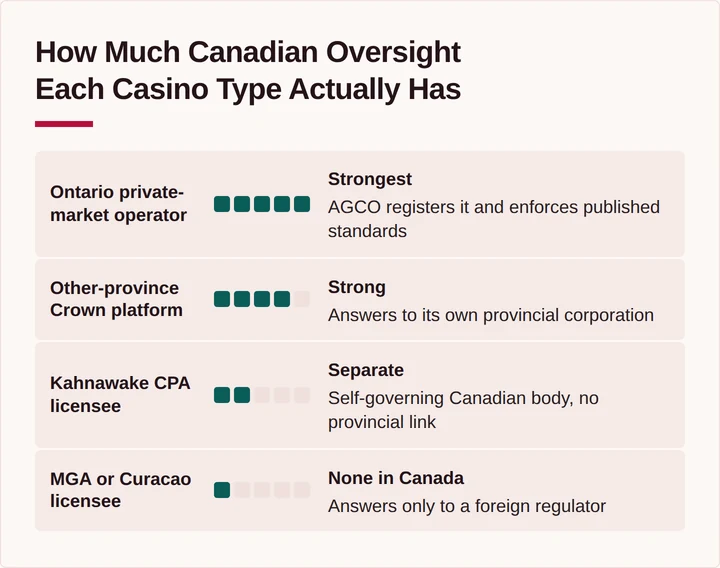
So when a Canadian says “local casino,” they mean one of two things depending on their province. It is either a Crown-corporation platform, or an AGCO-registered operator inside Ontario’s private market. A site licensed by the Kahnawake Gaming Commission is not a provincially licensed local casino, even though the territory sits inside Quebec.
The Real Strengths of a Provincially Licensed Platform
The advantages of a local platform are consequences of who holds the licence.
- A named regulator with published standards. An Ontario-registered operator answers to the AGCO, which writes binding standards for how the site must behave. A Crown platform answers to its provincial corporation. In both cases there is a Canadian body with authority over the operator.
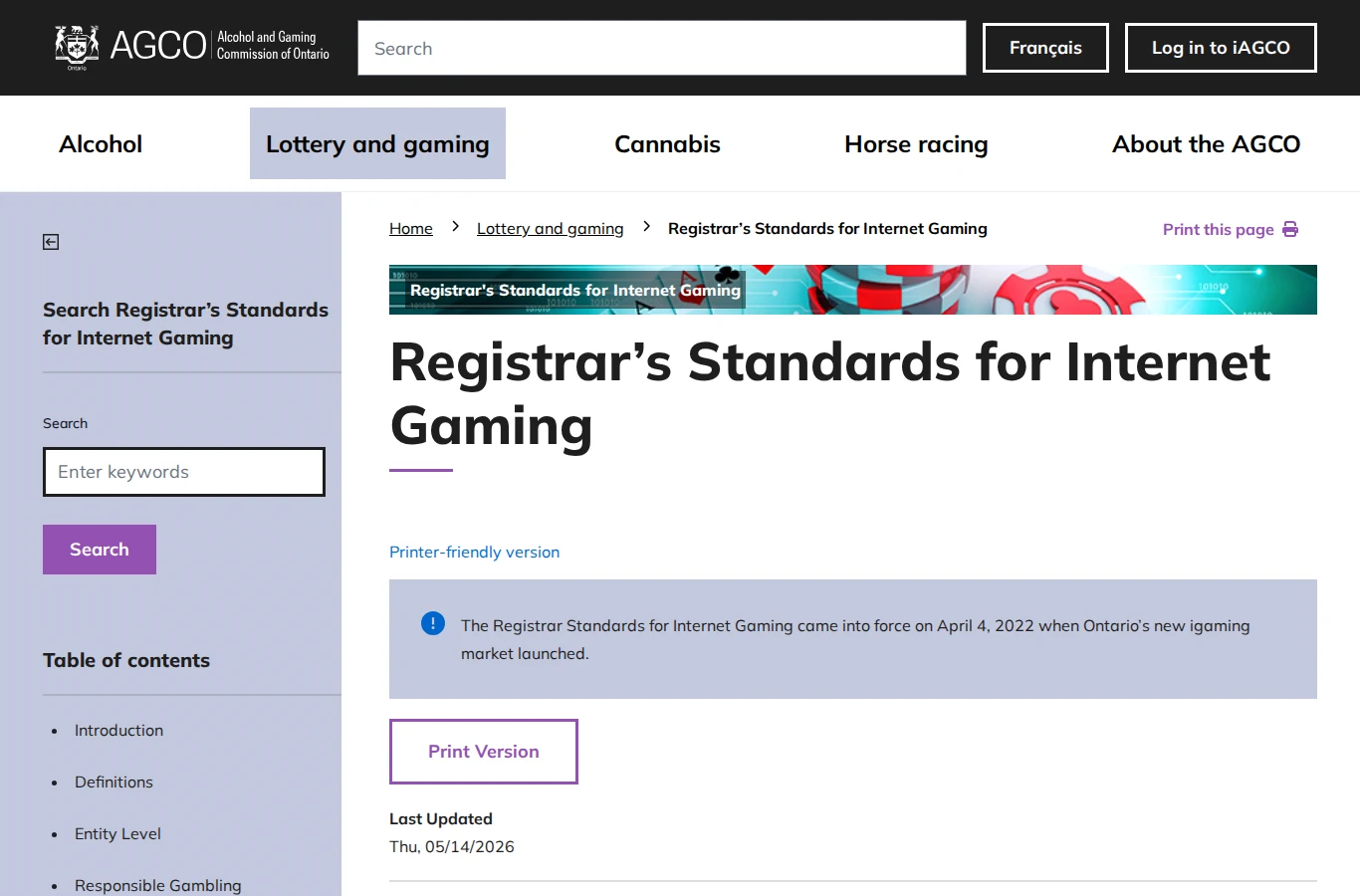
- Disclosure rules on bonuses. AGCO Registrar’s Standards for Internet Gaming, Standard 2.06, requires that any advertising or marketing communicating a gambling inducement, bonus, or credit disclose all material conditions and limitations of the offer at its first presentation on the gaming site, with all other conditions and limitations no more than one click away. The terms have to be visible where the offer is made.
- A design limit on steep wagering requirements. AGCO Standard 2.16 treats inducement, bonus, or credit offers that require excessive play to qualify as failing to meet the outcome of preventing extended, continuous, impulsive play. Ontario’s regulator frames an overly steep wagering requirement as a responsible-gambling design problem. That is a structural constraint on how aggressive a bonus can be.
- CAD-native accounts and Interac support. Crown platforms operate in Canadian dollars by default. Ontario-registered operators commonly support Interac e-Transfer, a real Canadian bank-to-bank instant payment rail, alongside cards. Settlement on that rail is same-day or near real-time.
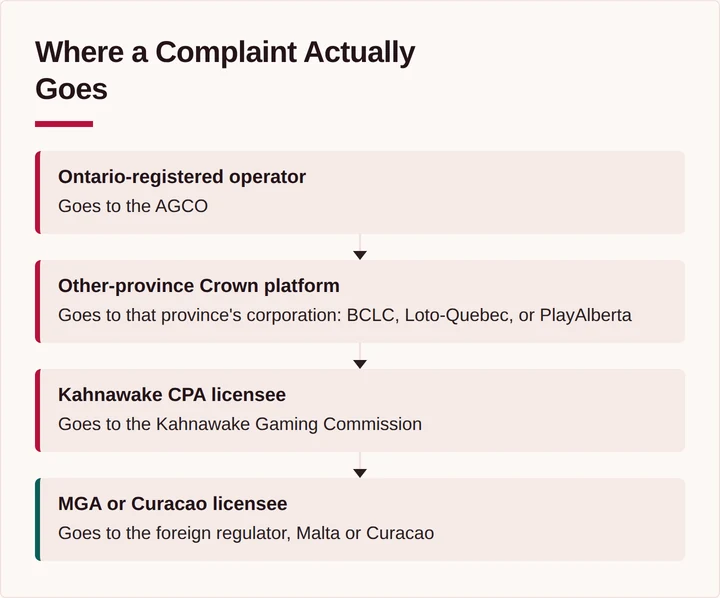
- Provincial recourse. A dispute with a provincially licensed platform goes to a Canadian regulator or corporation. That is a defined channel.
None of this makes a local platform better at everything. It makes the operator accountable to a specific body with specific published rules, which is a different kind of guarantee than a licence issued in another jurisdiction.
What an International Casino Actually Is
“International” covers at least three distinct licensing situations, and they carry different obligations.
The Kahnawake Gaming Commission is a self-governing First Nations regulatory body based in the Mohawk Territory of Kahnawake, Quebec. It was established in 1996. It issues Client Provider Authorization (CPA) licences with a five-year term, annually renewable, and requires server hosting within Kahnawake territory. Over 250 gaming sites operate under CPA licences. The commission is legally distinct from any provincial regulator, including the AGCO, BCLC, Loto-Québec, and PlayAlberta. A Kahnawake-licensed site sits in its own category, separate from both a provincially licensed Canadian casino and a typical offshore operator.
Many internationally facing sites instead hold a Malta Gaming Authority (MGA) licence or a Curaçao licence. Those are issued outside Canada entirely. The operator’s obligations run only to the issuing jurisdiction.
A Kahnawake CPA holder answers to the Kahnawake Gaming Commission. An MGA licensee answers to Malta. A Curaçao licensee answers to Curaçao. None of them answers to the AGCO, and none of them is bound by Ontario’s disclosure rule or its design-limit standard.
The Real Weaknesses of an International Site
The weaknesses follow directly from the licensing gap itself.
- No AGCO-style oversight. An international site is not bound by Ontario’s Registrar’s Standards. The bonus disclosure rule and the excessive-play design limit do not apply to it. Whatever terms it sets are governed by its own licence conditions and its own terms of service.
- No provincial recourse. A dispute with a provincially licensed platform has a Canadian destination. A dispute with an MGA or Curaçao licensee does not. The player is dealing with a foreign regulator under a foreign process.
- Currency friction. International and offshore sites commonly settle in USD or crypto by default. For a player holding Canadian dollars, that can add a currency-conversion step or fee. It is a typical friction point, but it is a real one, and it is absent on a CAD-native Crown platform.
- Payment rail mismatch. Interac e-Transfer is a Canadian bank-to-bank rail. It is not the default settlement method for a site built around USD or crypto. A player used to Interac may find the deposit and withdrawal path less familiar.
- Bonus terms set without the Ontario design constraint. Without that design-limit standard in the background, an international operator can attach a wagering requirement steep enough that Ontario’s regulator would treat it as a responsible-gambling failure. The player has to read the terms and judge for themselves.
The trade-off is that the specific protections Ontario wrote into its standards do not travel with the player onto an international site.
How Canadian Gambling Regulation Is Actually Structured
Canadian online gambling regulation sits entirely at the provincial level. There is no single national licensing body for casino operators, and the ten provinces have not converged on one model — Ontario’s competitive market and every other province’s Crown-corporation monopoly, covered above, are two different provincial answers to the same absent federal rule. For a fuller breakdown of how the provincial frameworks differ from each other, the site’s provincial regulations breakdown covers each jurisdiction in detail.
Three Structures, Compared Side by Side
| Ontario private market | Other-province Crown platform | Kahnawake or offshore international | |
| Who licenses it | AGCO registers; iGaming Ontario holds operating agreements | Provincial Crown corporation (BCLC, Loto-Québec, PlayAlberta) | Kahnawake Gaming Commission, MGA, or Curaçao |
| Legal status in Canada | Licensed local option in Ontario | Licensed local option in its province | Not a provincially licensed local casino |
| Bonus disclosure rule | Standard 2.06 applies | Set by the provincial corporation | Set by the operator and its foreign licence |
| Steep wagering limits | The design-limit standard treats excessive play to qualify as a design failure | Set by the provincial corporation | No Ontario design constraint applies |
| Default currency | CAD | CAD | Commonly USD or crypto |
| Interac e-Transfer | Commonly supported | Supported on CAD-native platforms | Not the default rail |
| Dispute destination | AGCO or the provincial framework | The provincial corporation | The foreign regulator (Kahnawake, Malta, Curaçao) |
| Game library breadth | Substantial | Substantial | Generally the broadest, across more providers |
The table is a map of accountability. Each row describes who is answerable to whom.
Payments and What They Cost the Player
A CAD-native platform costs a player nothing extra to move money in either direction. An international site’s USD-or-crypto default reverses that: the player’s own bank account is in Canadian dollars, so every deposit and withdrawal crosses a currency line, and that line carries a cost even when the operator doesn’t itemize it. The exact size depends on the operator and the payment method, but the bonus headline never states it.
Game Variety and Software Quality
Large international platforms generally carry more titles and more providers than any single provincially licensed platform. That is a fair general observation and it is the strongest genuine argument for an international site. A platform aggregating content from many studios across many jurisdictions has a wider catalogue by construction.
A Crown platform or an Ontario-registered operator draws from a smaller pool, because the content has to fit the provincial framework. The trade is breadth against the accountability structure described above. A player who values catalogue depth over the Ontario rulebook is making a coherent choice, as long as they know which one they are making.
Software quality is a separate question from catalogue size. Library size and software quality are two different measurements. The number of titles says nothing about how any individual title performs.
Bonus Value and the Terms Behind It
AGCO’s disclosure rule means bonus terms sit visibly where the offer is made. Its design-limit standard gives the player a reference point. If a bonus’s playthrough looks punishing, the AGCO’s own rules treat that as a design problem. Neither rule applies on an international site, where the wagering requirement is set and disclosed however the operator chooses. The player’s only defence there is reading the terms before accepting the bonus — the site’s guide to clearing casino bonuses and wagering requirements walks through how that playthrough math works in practice.
Which Structure Fits Which Player
What fits best depends on what the player values most.
A player in Ontario who wants a Canadian regulator with published standards, CAD-native accounts, Interac support, and a defined dispute channel is best served by an AGCO-registered operator. The cost is a smaller catalogue than the largest international platforms.
A player in BC, Manitoba, Saskatchewan, Quebec, or Alberta who wants a provincially licensed local option has one option. That option is their Crown platform. PlayNow, Espacejeux, or PlayAlberta. There is no private-operator alternative in those provinces today. Alberta’s private market has not opened yet.
A player who wants the broadest possible game library and is willing to accept a foreign licence, USD or crypto settlement, and a foreign dispute channel is choosing an international site. That is a legitimate trade, provided the player understands that Ontario’s bonus disclosure and excessive-play standards do not apply.
A player who wants to know whether their region even permits access to a given platform should understand that geolocation is what enforces these boundaries, which the site’s explainer on geolocation at online casinos covers.
The Bottom Line
Behind the words “local” and “international” sit three regulatory structures, each with its own rulebook, its own currency, and its own place to complain. Ontario’s private market under the AGCO and iGaming Ontario is the only competitive provincial model, and it carries the only Canadian bonus-disclosure and excessive-play standards described here. The other provinces run Crown monopolies with no private-operator alternative until Alberta’s planned launch. Kahnawake, MGA, and Curaçao licensees sit outside all of it, offering broader catalogues in exchange for foreign oversight and settlement friction. The right choice depends on which of those trade-offs the player actually wants.
FAQ
Is a Kahnawake-licensed casino a local Canadian casino? No. The Kahnawake Gaming Commission is a self-governing First Nations regulatory body based in the Mohawk Territory of Kahnawake, Quebec, established in 1996, and it is legally distinct from every provincial regulator, including the AGCO, BCLC, Loto-Québec, and PlayAlberta. It issues Client Provider Authorization licences with a five-year term, annually renewable, and requires server hosting within Kahnawake territory, with over 250 gaming sites operating under those licences. A site holding a CPA licence is a legally operating Canadian-adjacent operator, but it is not a provincially licensed local casino, and it is not bound by Ontario’s Registrar’s Standards.
Does Ontario’s bonus disclosure rule apply to international casinos? No. AGCO’s bonus-disclosure standard applies to operators registered in Ontario’s market, and it requires that advertising or marketing communicating a gambling inducement, bonus, or credit disclose all material conditions and limitations at the offer’s first presentation on the gaming site, with the rest no more than one click away. An MGA or Curaçao licensee is not registered in Ontario and is not bound by that standard. The player’s protection on an international site is their own reading of the terms.
Why does the AGCO treat a steep wagering requirement as a safety issue? The design-limit standard named above treats inducement, bonus, or credit offers that require excessive play to qualify as failing to meet the outcome of preventing extended, continuous, impulsive play. Ontario’s regulator frames an overly steep wagering requirement as a responsible-gambling design problem. That means a bonus structure demanding punishing playthrough is, under Ontario’s own standards, a design failure. On an international site, no equivalent constraint applies.
Can I get a provincially licensed private casino outside Ontario? No. Every province other than Ontario runs a single Crown-corporation monopoly platform. BCLC’s PlayNow serves British Columbia, Manitoba, and Saskatchewan; Loto-Québec runs Espacejeux in Quebec; and PlayAlberta runs in Alberta. No private online casino brand can legally operate as a licensed local option in those provinces today. Alberta passed the iGaming Alberta Act to open a private-operator market, but that launch has not happened yet, so describing Alberta as an open private market today is premature. When the market does open, Alberta would become the second province with a competitive private structure alongside Ontario, giving players there a choice that does not currently exist.
How do payment methods differ between local and international platforms? Crown platforms operate in Canadian dollars by default, and Ontario-registered operators commonly support Interac e-Transfer alongside cards. Interac e-Transfer is a Canadian bank-to-bank instant rail, and settlement on it is same-day or near real-time, so a CAD-holding player moves money without a conversion step. International and offshore sites commonly settle in USD or crypto by default, which can add a currency-conversion step or fee for a player holding Canadian dollars. The exact cost depends on the operator and the method, but the friction is structural.
Does an international casino have more games than a provincial platform? Generally yes. Large international platforms typically carry more titles and more providers than any single provincially licensed platform, because they aggregate content across many studios and jurisdictions. That breadth is the strongest genuine argument for an international site. It does not change the accountability structure. The operator still answers to a foreign regulator, and Ontario’s bonus disclosure and excessive-play standards still do not apply to it.