
Canadian Online Gambling Laws Explained: Provincial Regulations Breakdowns

How Gambling Law Is Split in Canada
Canada does not have one online gambling law. It has a federal boundary with provincial licensing authorities operating inside it.
The federal Criminal Code sets the outer legal limit. It historically prohibited gambling except where a specific carve-out applied. A 1985 amendment changed that arrangement by devolving the authority to license and regulate gambling, including lotteries and casino-style gaming, to the provinces. Ottawa kept the criminal-law frame. The provinces got the actual power to decide what is legally offered inside their borders, who may offer it, and under what standards.
A province is not a market segment inside a national system. It is the licensing authority. What a player in Ontario can legally access differs from what a player in Quebec or British Columbia can legally access, because three different regulators made three different structural choices.
What a Provincial Licensing Authority Actually Controls
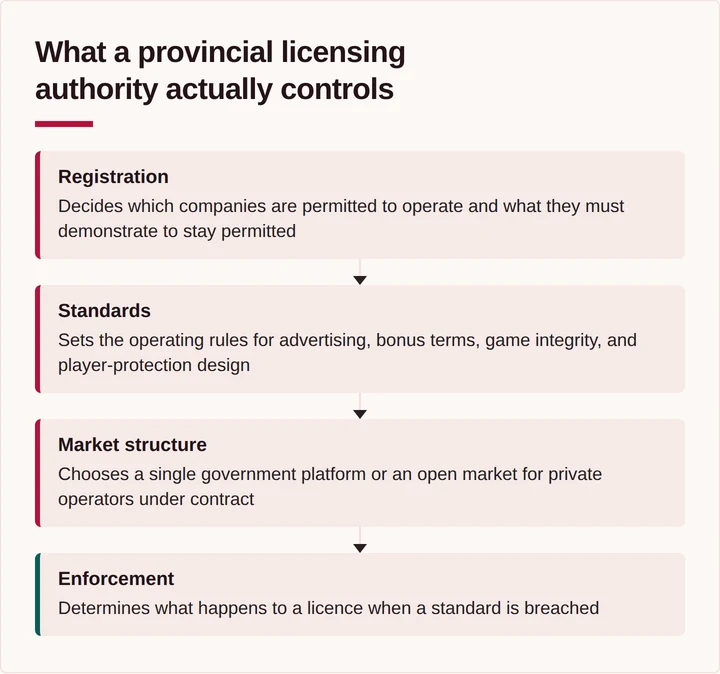
When a province holds licensing authority, it controls four concrete things.
Registration determines which companies are permitted to operate and what they must demonstrate to stay permitted. Standards are the operating rules those companies must follow, covering advertising, bonus terms, game integrity, and player-protection design. Market structure is whether the province runs a single government platform or opens the market to private operators under contract. Enforcement is what happens to a licence when a standard is breached.
Each regulator is a named body with statutory authority. In Ontario that is the Alcohol and Gaming Commission of Ontario (AGCO). In British Columbia it is the British Columbia Lottery Corporation (BCLC). In Quebec it is Loto-Québec. In Alberta it is PlayAlberta. Each of these bodies answers to its own province, and none of them answers to a national gambling regulator, because Canada does not have one.
Why Provincial Systems Differ
Each province makes one structural choice, and that choice is what actually separates them. A province can either open the market to private operators under a provincial licence, or run a single government Crown-corporation platform.
Ontario chose the open market. Every other province chose the monopoly model. That is the whole of the divergence, and it produces the practical differences players notice, from how many sites are available to which regulator a complaint goes to.
Ontario: The Open, Privately Operated Market
Ontario launched its competitive, privately-operated online casino market on April 4, 2022. It is the only Canadian province with this structure.
Two bodies run it. The Alcohol and Gaming Commission of Ontario registers and regulates every operator in the market. iGaming Ontario holds the commercial operating agreements that run the market day to day. An operator in Ontario therefore needs two things. First, AGCO registration; second, an operating agreement with iGaming Ontario. Neither alone is sufficient.
Roughly 49 operators run about 84 licensed gaming sites in Ontario under that arrangement. A player in Ontario is choosing between provincially registered operators that all sit under the same regulator and the same standard set, unlike the fragmented regulatory landscape of sites licensed across different jurisdictions.
British Columbia: BCLC and PlayNow
British Columbia runs the monopoly model through the British Columbia Lottery Corporation and its platform, PlayNow, the sole legal option for real-money online casino play in the province.
BCLC’s reach extends beyond BC’s borders. Through BCLC, PlayNow also serves Manitoba and Saskatchewan. That makes it the widest-reaching Crown platform in the country by province count, with the licensing authority remaining a separate provincial body in each jurisdiction.
Quebec: Loto-Québec and Espacejeux
Quebec runs the same monopoly structure through Loto-Québec, whose online platform is Espacejeux. As in BC, there is no private-operator market. Loto-Québec is both the provincial lottery corporation and the operator of the province’s legal online casino offering, which concentrates licensing authority and commercial operation in one body.
Alberta: PlayAlberta, With a Market Change Pending
Alberta currently runs PlayAlberta as its Crown-corporation platform, on the same monopoly model as BC and Quebec.
That is scheduled to change. Alberta passed the iGaming Alberta Act in 2025 to open a private-operator market, with launch planned for 2026. As of now the private market is not live. Alberta remains a single-platform province, and any description of it as an open market is describing something that has not happened yet.
The Remaining Provinces
The provinces not named above follow the same Crown-corporation pattern, coordinating through regional Crown-lottery bodies in the Atlantic region. These provinces license through their own provincial Crown bodies, and no private online casino brand operates there as a licensed local option today.
Comparison Table: The Three Licensing Situations
| Situation | Who licenses it | What it means for a player |
| Ontario | AGCO registers the operator; iGaming Ontario holds the operating agreement | Choosing between roughly 49 operators across about 84 licensed sites, all under one provincial regulator and one standard set |
| Other provinces | Provincial Crown corporation (BCLC PlayNow in BC, Manitoba and Saskatchewan; Loto-Québec Espacejeux in Quebec; PlayAlberta in Alberta) | One legal provincial platform; no private brand can operate as a licensed local option |
| Kahnawake-licensed sites | Kahnawake Gaming Commission, a self-governing First Nations regulator in the Mohawk Territory of Kahnawake, Quebec | Operating under a separate licensing jurisdiction with its own regulatory rules |
| Offshore sites | Malta Gaming Authority or Curaçao, typically | Operating entirely outside provincial licensing with regulatory authority in another country |
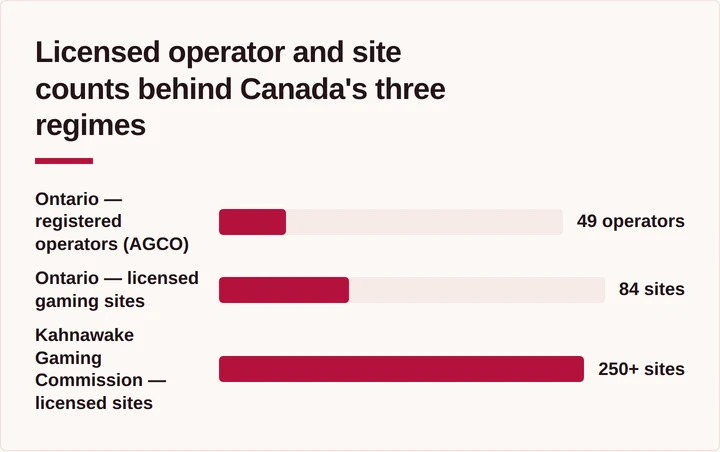
The third and fourth rows cover licences that sit outside provincial regulation entirely. A site holding a Kahnawake Gaming Commission licence operates under a separate First Nations licensing regime outside provincial jurisdiction. The Kahnawake Gaming Commission is a self-governing First Nations regulatory body based in the Mohawk Territory of Kahnawake, Quebec, established in 1996. It issues Client Provider Authorization licences on a five-year term, renewable annually, and requires server hosting within Kahnawake territory. Over 250 gaming sites operate under those licences. It is legally distinct from AGCO, BCLC, Loto-Québec, and PlayAlberta, and a CPA licence carries no provincial registration.
Many internationally-facing sites instead hold a Malta Gaming Authority or Curaçao licence. Those operate outside Canadian provincial licensing altogether. The distinction matters at the point of a dispute. A provincially registered operator answers to a provincial regulator with statutory powers. An offshore licensee answers to a regulator in another country under that country’s rules. The comparison of locally licensed and internationally licensed casinos for Canadian players is built entirely around that gap in regulatory reach, since it decides who actually answers for a dispute once a player files one.
Responsible Gambling Rules: Where They Bite
Two Ontario standards govern things players actually encounter.
AGCO Registrar’s Standards for Internet Gaming, Standard 2.06, governs advertising and marketing. Where a permitted communication carries a gambling inducement, bonus, or credit, it must disclose all material conditions and limitations of that offer at its first presentation on the gaming site. Every other condition and limitation must be no more than one click away. The practical effect requires that bonus terms travel with the headline or sit one click behind it.
Standard 2.16 addresses inducements, bonuses, and credits that require excessive play to qualify. Steep playthrough or wagering requirements fall into that category. The regulator’s position is that an overly steep wagering requirement fails the outcome of preventing extended, continuous, and impulsive play. Ontario therefore treats a punishing wagering requirement as a responsible-gambling design problem, prioritizing player protection alongside bonus fairness. That framing is unusual, and it changes what an operator can put in front of a player. This is why some wagering requirements prove far harder to clear than their headline percentage initially suggests—the guide to how wagering requirements work and how bonuses get cleared walks through why bonus terms matter so much to real clearing costs.
Other provinces apply their own responsible-gambling requirements through their Crown corporations. The specific standard numbers cited above are Ontario’s, and they should not be attributed to BCLC, Loto-Québec, or PlayAlberta.
Payments: What the Licensing Model Changes
Payment mechanics follow the licensing model more than most players expect.
Interac e-Transfer is a real, widely used Canadian bank-to-bank instant payment rail. Ontario-registered operators commonly support it alongside cards. Settlement on that rail is same-day or near real-time, and it keeps the transaction in Canadian dollars between Canadian accounts.
International and offshore sites commonly settle in USD or crypto by default. For a player holding Canadian dollars, that introduces a currency-conversion step, and conversion typically carries a fee. The amount of friction varies by site and payment method, changing from one transaction to the next. Provincially registered operators are built around Canadian banking infrastructure; offshore licensees operate on different banking rails. That structural difference explains the payment patterns.
Where the Rules Leave a Canadian Player
The federal Criminal Code sets the boundary. The provinces hold the licensing power. Ontario is the only province where that power has been used to create a competitive private market, and it has been running since April 4, 2022, under AGCO registration and iGaming Ontario operating agreements. Every other province runs a single Crown-corporation platform—BCLC’s PlayNow, Loto-Québec’s Espacejeux, PlayAlberta. Alberta has legislated a private market with launch scheduled for the following year, and it is not live yet.
Sites licensed by the Kahnawake Gaming Commission, or by the Malta Gaming Authority or Curaçao, operate outside that provincial structure entirely. Their regulatory authority rests with those licensing bodies alone.
A player’s legal options are determined by which province they are in, and the province they are in determines which regulator, if any, is accountable for what they are playing on. The explainer on geolocation at online casinos and why region decides what a player can access centers on exactly this mechanism, the automatic province confirmation that in turn determines which regulator, if any, is accountable for what a player is on.
FAQ
Is online gambling legal in Canada?
It is legal where a province has authorized it, and the provinces are the bodies that decide. The federal Criminal Code sets the outer boundary and historically prohibited gambling except where explicitly carved out; the 1985 amendment devolved the authority to license and regulate gambling, including lotteries and casino-style gaming, to the provinces. That means there is no single national answer. A platform operating under a provincial licence is legal in that province, and the province’s regulator is the body accountable for it. A site operating under a Kahnawake, Malta, or Curaçao licence operates under a separate international or First Nations authority, which is a different legal situation even when the site is accessible from Canada.
Why can I play on more sites in Ontario than in other provinces?
Because Ontario is the only province that opened its market to private operators under provincial licence. It launched that market with AGCO registering and regulating every operator and iGaming Ontario holding the commercial operating agreements. Roughly 49 operators run about 84 licensed gaming sites under that structure. Every other province runs a single government Crown-corporation platform instead, leaving only one legal provincial option available to players. The difference stems from market structure: whether the province licenses multiple operators or runs a single Crown platform.
Is a Kahnawake-licensed casino the same as a provincially licensed one?
No. The distinction is a substantive legal one rooted in separate regulatory jurisdiction. The Kahnawake Gaming Commission is a self-governing First Nations regulatory body based in the Mohawk Territory of Kahnawake, Quebec, established in 1996. It issues Client Provider Authorization licences on a five-year term, renewable annually, and requires server hosting within Kahnawake territory; over 250 gaming sites operate under those licences. It is legally distinct from AGCO, BCLC, Loto-Québec, and PlayAlberta. A Kahnawake-licensed site operates under First Nations regulatory authority separate from provincial licensing, with no provincial regulator having authority over it.
What do Ontario’s bonus rules actually require?
Two AGCO standards do most of the work. Standard 2.06 requires that where permitted advertising or marketing communicates a gambling inducement, bonus, or credit, all material conditions and limitations of that offer are disclosed at its first presentation on the gaming site, with all other conditions and limitations no more than one click away. Standard 2.16 treats inducements, bonuses, or credits that require excessive play to qualify as failing the outcome of preventing extended, continuous, and impulsive play. In practice, a steep wagering requirement is treated as a responsible-gambling design problem emphasizing player protection over bonus value, and a bonus headline must have its terms attached or one click behind it.
Is Alberta’s private online casino market open yet?
No. Alberta passed the iGaming Alberta Act in 2025 to open a private-operator market, with launch scheduled for the following year. Until that happens, Alberta runs PlayAlberta as its Crown-corporation platform on the same monopoly model as British Columbia and Quebec.
Does the province I live in affect how I get paid?
It affects which licensing model stands behind the site, and that shapes the payment rails available. Ontario-registered operators commonly support Interac e-Transfer, a Canadian bank-to-bank instant rail, alongside cards, with settlement that is same-day or near real-time and stays in Canadian dollars. International and offshore sites commonly settle in USD or crypto by default, which for a player holding Canadian dollars adds a currency-conversion step and typically a fee. The size of that friction varies by site and payment method.