
Withdrawal Speed by Payment Method: The AML and Bank Layers Casinos Don’t Advertise

Casino withdrawal speed is set by two layers sitting on top of the operator’s approval step. The first is the AML/KYC checkpoint the money must clear. The second is the bank or network that has to move it. A “fast withdrawal” banner describes the casino’s internal release. The time until funds land is a separate matter. The rail a player picks decides most of the wait. Ontario’s AGCO standards, FINTRAC reporting rules, and card-network merchant codes each impose a different floor.
KYC Timing: The Check at Withdrawal Is a Re-Check
Identity verification in Ontario is supposed to be finished before the account exists, which makes the withdrawal-stage check a second pass. The AGCO Registrar’s Standards for Internet Gaming require operators to collect and validate name, date of birth, address, contact details, and the identity information required under the Proceeds of Crime (Money Laundering) and Terrorist Financing Act before an Ontario-regulated account is opened.
The mechanism matters because players often blame the withdrawal queue for a delay that is really a re-verification. At payout, the operator must confirm the withdrawal is being made by the account holder and paid into an account that same person legally holds. That is a matching exercise. The name on the casino account is checked against the name on the bank account or wallet. A mismatch, an expired document, or a changed address stalls the payout regardless of how fast the rail itself is.
The consequence is concrete. A player who opened an account years ago under an old address, or who deposits from a shared or third-party account, hits a manual review at the worst moment. The fix happens before the request. Keep the registered name identical across the casino account, the bank account, and any e-wallet. The internal approval step then has nothing to query.
The $10,000 Threshold and the 24-Hour Aggregation Rule
A withdrawal of $10,000 or more triggers additional verification before payout, and FINTRAC’s 24-hour rule can pull smaller withdrawals into the same reporting bucket. The AGCO standard states that where winnings are $10,000 or more, extra verification must take place before the operator pays out. That is an enhanced-check trigger.
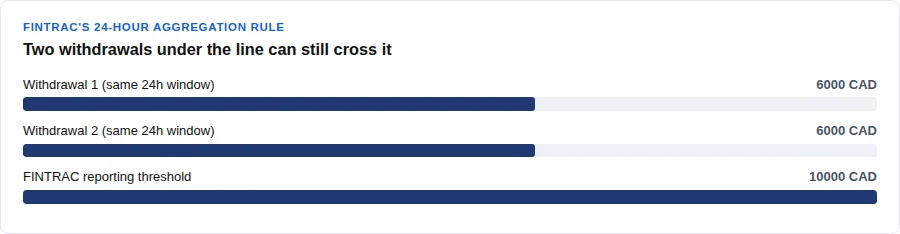
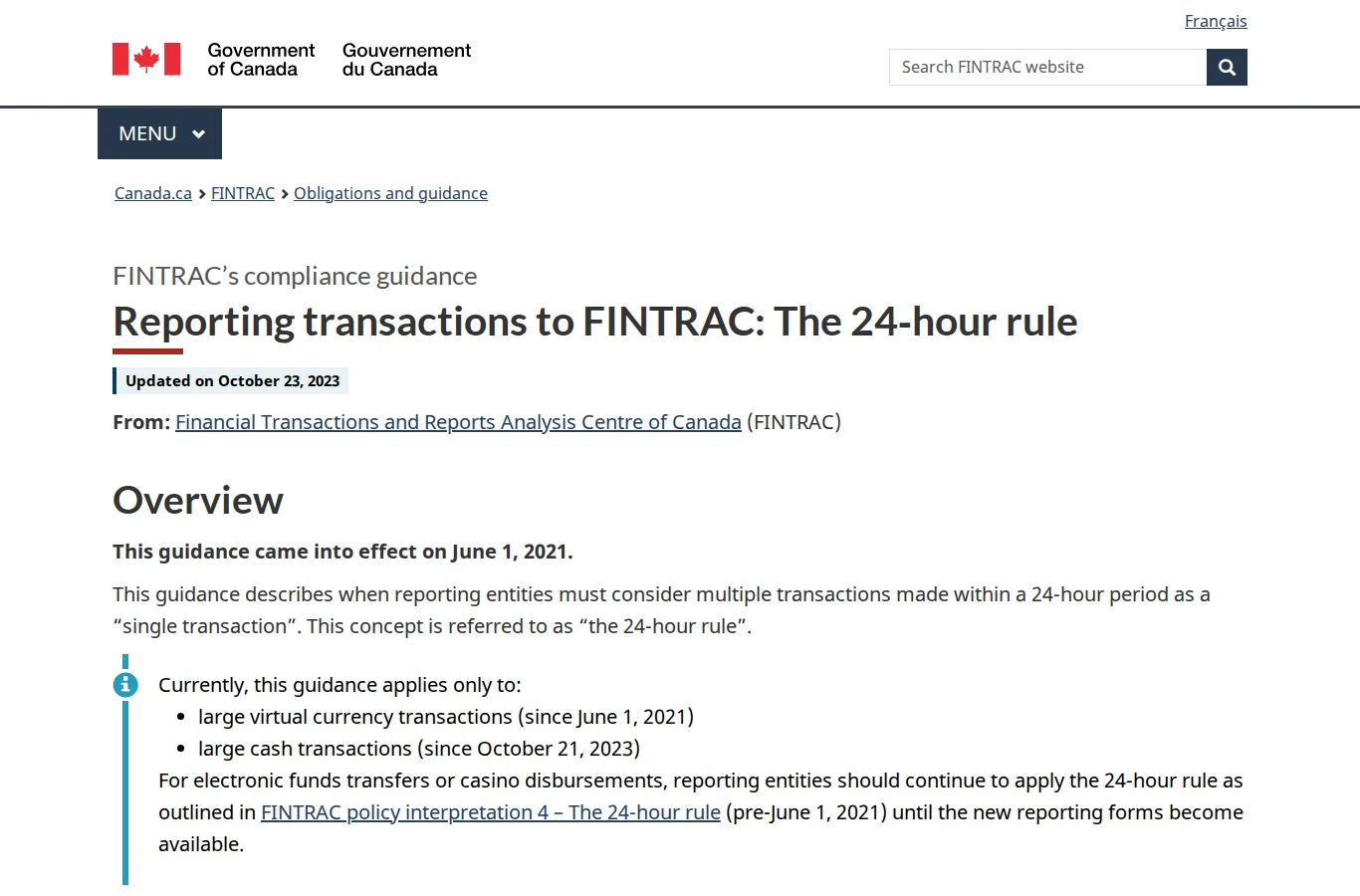
FINTRAC sits underneath it. A casino disbursement report, an electronic funds transfer report, or a large cash transaction report is triggered at $10,000 CAD in a single transaction, or by two or more transactions totalling $10,000 or more within a consecutive 24-hour window. That second clause is the aggregation rule. Two $6,000 withdrawals inside that window can aggregate into a reportable event even though neither one crosses the line alone.
The report itself must reach FINTRAC within 15 calendar days of the transaction. That timeline runs on the operator’s side and does not by itself hold up a payout, but the enhanced verification that precedes a $10,000-plus payment does add a checkpoint the player feels.
The timing standard is softer than players assume. The AGCO requires withdrawals to be paid “as soon as is practicable” after verification, which is not a fixed clock. There is no regulatory deadline on the payout itself. A stated same-day figure is an operator service target, and it carries no statutory force.
How Each Rail Sets Its Own Floor

Each payment method adds a different layer after the casino approves the payout, and that layer usually decides the arrival time. The bands below are typical industry ranges.
Interac e-Transfer
Interac e-Transfer is the fastest Canadian-dollar rail once the payout is approved, commonly same-day. At a verified account the transfer can land in minutes to a few hours. Slower operators can still take a day or two because their internal approval queue sits in front of the transfer. The floor here is the casino’s own release plus the Interac deposit mechanics, with no separate wallet AML pass and no receiving-bank hold in the ordinary case. For a player already banking in Canadian dollars, it removes the most checkpoints. The trade-off is that the name on the Interac profile has to match the casino account, or the re-check described above kicks in.
E-Wallets
E-wallets such as Skrill, MuchBetter, Instadebit, and Neteller-type services commonly clear in 1-2 business days after the casino’s internal approval. The extra day comes from a specific mechanism. The wallet provider runs its own independent AML/KYC check on top of the casino’s. Two compliance systems, two queues. A player who has not fully verified the wallet account adds a third delay. The wallet beats a bank wire and trails Interac because the provider is a separate regulated entity with its own obligations.
Bank Wire
Bank wire or traditional bank transfer is commonly the slowest common rail at 2-7 business days. The mechanism is layered screening. The transfer passes through the receiving bank’s own hold and AML screening on top of the casino’s approval. The casino can release in hours and the money still sits in the banking system for most of a week.
Credit Card
Credit card withdrawals are constrained before speed even enters the picture. Card networks require gambling transactions to carry merchant code 7995 (betting/casino gaming), per the Visa Merchant Data Standards Manual. Most issuers treat that code as a cash-equivalent or cash-advance category, which can mean higher interest, no grace period, and sometimes a lower sub-limit. Payments-industry coverage names RBC, TD, Scotiabank, BMO, and CIBC as Canadian banks applying this policy, with some declining the code outright.
Because of that treatment, casinos typically cap a card withdrawal at the amount the player originally deposited by card. Winnings above that figure have to leave by a different method entirely. Even within the cap, settlement follows the card network’s own batch cycle. A card withdrawal is therefore both capped and slow, and it is the weakest rail for a player whose balance exceeds their deposits.
Crypto
Crypto payouts run on two separate clocks, and the casino controls only the first. Step one is the casino’s own approval and AML check, identical in kind to any other method. Step two is the blockchain network’s confirmation time, which the casino does not control. Bitcoin typically confirms in roughly 10-60 minutes depending on network congestion. Solana and TRC-20 stablecoin transfers typically clear in single-digit minutes.
KYC on the crypto rail is usually triggered by a cumulative withdrawal threshold, commonly cited in the C$2,000 to C$10,000 range depending on the operator’s own AML policy. That cumulative trigger means a series of small crypto withdrawals can trip verification without any single one looking large. Gambling businesses serving Canadian players are themselves FINTRAC reporting entities regardless of which rail the money moves on, so crypto carries the same reporting layer described above.
Comparison Table: Five Rails, Five Floors
| Rail | Typical processing band | What sets the floor | Cap or KYC trigger |
|---|---|---|---|
| Interac e-Transfer | Same-day; minutes to a few hours at a verified account, up to a day or two at slower operators | Casino internal approval plus Interac deposit mechanics; no separate wallet AML pass | Name match on the Interac profile; enhanced check at $10,000+ |
| E-wallets (Skrill, MuchBetter, Instadebit, Neteller-type) | 1-2 business days after casino approval | Wallet provider’s own independent AML/KYC check, a second compliance queue | Wallet account must be verified; enhanced check at $10,000+ |
| Bank wire | 2-7 business days | Receiving bank’s hold and AML screening on top of the casino’s | Enhanced check at $10,000+ |
| Credit card | Capped at original card deposit; settlement on the card network’s batch cycle | MCC 7995 cash-equivalent treatment; issuer policy at RBC, TD, Scotiabank, BMO, CIBC | Withdrawal limited to amount deposited by card; excess must use another rail |
| Crypto | Approval plus network time (Bitcoin ~10-60 minutes, Solana/TRC-20 single-digit minutes) | Blockchain confirmation time, outside casino control | Cumulative withdrawal KYC trigger commonly C$2,000-C$10,000 |
When a Withdrawal Stalls Past the Advertised Window
The backstop for a stalled withdrawal is the iGaming Ontario complaint-handling service standard, and it runs on a business-day clock. A player complaint must be acknowledged within 1 business day. The operator then has up to 90 days to respond to a dispute.
That structure tells the player what that same-day figure actually is. It is an operator service target. iGaming Ontario’s own service standard sets two windows instead, the acknowledgment window and the dispute-response window. A payout that misses an advertised same-day promise has not necessarily missed anything iGaming Ontario tracks. A complaint that goes unacknowledged past 1 business day, or a dispute left unanswered past the response period, has.
The practical consequence is that the player should document the request date, the amount, and the rail. The player should then escalate through the operator’s formal complaints process first. The iGaming Ontario standard is the layer above that. It is a paper trail mechanism. Players who expect a regulator to force a payout within hours are working from the marketing. The standard sets out a process instead.
What a Player Can Actually Do
Three levers are available before a withdrawal is requested, and each maps to a checkpoint described above. None of them overrides the AML layer, but each removes a queue.
Pick the rail with fewer checkpoints. For a Canadian-dollar payout under the enhanced-check threshold, Interac e-Transfer carries the fewest layers. It has no separate wallet AML pass and no receiving-bank wire hold. E-wallets add a provider check. Wires add bank screening. Cards add a cap. Crypto adds a network clock the casino cannot shorten.
Know that the $10,000 threshold exists, and that it aggregates. The enhanced verification at $10,000 or more is a fixed trigger under the AGCO standard, and FINTRAC’s aggregation rule can pull two smaller withdrawals into one reportable total. A player planning a large payout should expect the extra check and build time for it. Splitting withdrawals does not help, because the threshold aggregates them anyway.
Do not treat a stated same-day figure as a guarantee. The AGCO standard is “as soon as is practicable” after verification, and the enforceable backstop is the iGaming Ontario complaint process with its 1-business-day acknowledgment and the dispute-response period. The number on the marketing page is a target. The number in the standard is a process.
Two housekeeping points cut real time. Keep the registered name identical across the casino account, bank account, and any wallet, which can shorten the account-holder re-check at payout. And understand that bonus funds tied up in wagering requirements cannot be withdrawn at all until cleared, so a balance that looks ready may still be locked behind playthrough. The mechanics of clearing those terms are covered in the guide to understanding wagering requirements and clearing casino bonuses faster.
The provincial rulebook behind all of this, including which regulator applies in each province, is set out in the breakdown of Canadian online gambling laws and provincial regulations. Players who want to track deposit and withdrawal limits against their own budget can use the responsible gambling tools available in Canadian online casinos, which include deposit caps that operate on the same account layer as the KYC checks described above.
Frequently Asked Questions
Why is my Interac e-Transfer withdrawal slower than the casino promised?
The casino’s internal approval step sits in front of the Interac transfer, and the account-holder re-check under the AGCO standard has to clear first. If the name on the Interac profile does not match the casino account, the payout goes to manual review. Once approved, Interac is the fastest Canadian-dollar rail, commonly same-day.
Does a $10,000 withdrawal always trigger extra checks?
Yes. The AGCO standard requires additional verification before payout where winnings are $10,000 or more. FINTRAC’s aggregation rule can also pull two or more transactions totalling $10,000 or more within the same rolling window into a single reportable event, so splitting a payout does not avoid the threshold.
Why can I only withdraw part of my balance to a credit card?
Card networks require gambling transactions to carry merchant code 7995, which most issuers treat as a cash-equivalent or cash-advance category. Casinos typically cap a card withdrawal at the amount originally deposited by card, and winnings above that have to leave by another method. RBC, TD, Scotiabank, BMO, and CIBC are named in payments-industry coverage as applying this policy.
How long does a crypto withdrawal actually take?
Two clocks run. The casino’s approval and AML step is identical in kind to any other rail. The blockchain confirmation is separate and outside the casino’s control. Bitcoin typically confirms in roughly 10-60 minutes depending on congestion, and Solana and TRC-20 stablecoin transfers typically clear in single-digit minutes. KYC on crypto is usually triggered by a cumulative withdrawal threshold, commonly C$2,000 to C$10,000 depending on the operator’s policy.
What can I do if a withdrawal stalls past the advertised window?
Use the operator’s formal complaints process and keep the request date, amount, and rail on record. Under the iGaming Ontario service standard, a complaint must be acknowledged within 1 business day, and the operator has up to 90 days to respond to a dispute. That is the enforceable backstop. A same-day payout guarantee is a separate thing.