
Understanding Wagering Requirements: How to Clear Casino Bonuses Faster

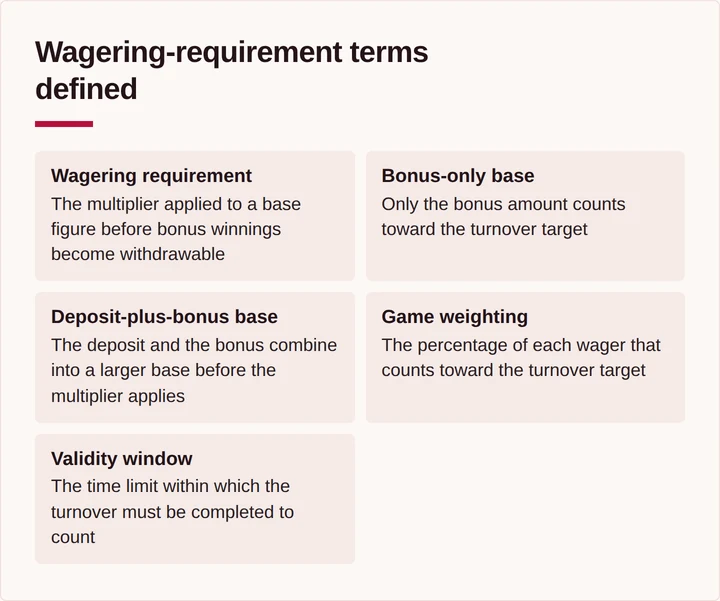
A wagering requirement is the amount that must be bet before bonus winnings become withdrawable. It is usually written as a multiplier: 10x, 20x, 40x. The multiplier applies to a base figure, and that base figure is the single most important number in the offer. Ontario’s regulator, the Alcohol and Gaming Commission of Ontario (AGCO), treats an excessively steep requirement as a responsible-gambling design failure under Standard 2.16.
What Wagering Requirements Mean
The requirement is a turnover target. Clearing requires bets totalling the target before the operator releases bonus-derived winnings for withdrawal. Until the target is met, the funds sit in a restricted balance.
A 10x requirement on a $100 bonus produces a $1,000 turnover target. At $10 per spin, that is 100 spins of pure turnover, assuming every bet counts fully toward clearing. The multiplier is not a fee and it is not deducted from the balance. It is a condition of release.
Two variables change the real cost. The first is the base. That base is either bonus-only or deposit-plus-bonus. The second is game weighting, which determines how much of each bet actually counts. A $1,000 target cleared at 100% weighting is a $1,000 target. The same target cleared at 20% weighting is effectively a $5,000 target in cash terms.
The requirement also interacts with time. A validity window sets a deadline for the turnover, and turnover completed after the window closes does not count. A steep multiplier plus a short window is a different proposition from the same multiplier with a generous window, even though the headline number is identical.
Why Wagering Rules Matter
Ontario’s Registrar’s Standards for Internet Gaming set the frame. Standard 2.16 requires that bonus, inducement and credit promotions “help prevent extended, continuous and impulsive play, and facilitate low risk play behaviours.” The same standard states directly that offers “that require excessive play to qualify (e.g. significant playthrough requirements) would not meet this outcome.”
That language matters because it reframes the requirement. A steep multiplier is a design defect in the promotion itself under Ontario’s framework, and the regulator says so in the standard text.
A second AGCO standard governs when the number must be shown. Standard 2.06 requires operators to “disclose all material conditions and limitations of the offer at its first presentation on the gaming site, with all other conditions and limitations no more than one click away.” A wagering-requirement number is a material condition. It must be visible when the offer is first presented, and it cannot sit three screens deep in a terms page.
There is a structural reason players often do not see the number early. Standard 2.05 bars public advertising of gambling inducements, bonuses and credits, which covers billboards, broadcast, social and algorithmic ads. Specific bonus terms may only be shown to a player once that player is already on the operator’s own gaming site, or through direct marketing to a player who actively opted in, which Standard 2.07 governs. The real requirement is therefore rarely visible before sign-up. It appears at first presentation on the site, which is where the disclosure standard requires it. Ontario’s rules sit inside a larger patchwork; how Canadian provinces regulate online gambling covers how the frameworks differ.
Types of Wagering Requirements
The structure of the requirement determines the size of the target more than the multiplier does. Four structures built around a turnover target cover the standard forms, with a fifth that removes the requirement entirely.
Bonus-Only Wagering
The multiplier applies to the bonus amount alone. A $100 bonus at 20x produces a $2,000 turnover target. This is the smaller of the two standard bases, and it is generally the more favourable structure for the player.
Deposit-Plus-Bonus Wagering
The multiplier applies to the deposit and the bonus combined. A $100 deposit matched by a $100 bonus creates a $200 combined base. At 20x, that base produces a $4,000 turnover target. The multiplier is the same; the target is double. Reading which base applies is the first thing to check in any terms page, because the two structures are frequently described with identical headline multipliers.
Game-Specific Wagering
Some offers restrict clearing to particular game categories, or apply different multipliers depending on what is played. A slots-only requirement is one common form. These offers can be workable for a player who already plays the qualifying category, and expensive for one who does not, because play outside the category may contribute nothing at all.
Free Spin Wagering
Winnings from free spins are often subject to their own requirement, separate from any deposit bonus attached to the same promotion. The spin itself is free; the winnings it produces are not. A free-spin offer with a high multiplier on winnings can carry a larger effective target than a modest deposit bonus, which is why the winnings terms deserve the same reading as the deposit terms.
No-Wager Bonuses
A no-wager or wager-free bonus allows withdrawal of winnings without a turnover target. These are rare and usually smaller than standard offers, and they may carry other conditions such as a maximum withdrawal cap. The absence of a multiplier removes the clearing problem entirely, which is the whole point of the structure.
Game Contribution and Progress Speed
Not every bet counts equally toward clearing. Game weighting is the percentage of each wager that is applied to the turnover target. Slots commonly count at or near 100%. Table games such as blackjack, roulette and video poker commonly count at a reduced percentage, and some categories may be excluded from clearing altogether.
Weighting varies by game category and by operator. These are common industry ranges, and the actual weighting for any specific offer is set by the operator and stated in its terms.
| Game category | Commonly applied weighting | Effect on a $1,000 target |
| Slots | Often at or near 100% | Roughly $1,000 in bets to clear |
| Table games (blackjack, roulette) | Often reduced | Target effectively multiplies by the inverse of the weighting |
| Video poker | Often reduced or excluded | May contribute little or nothing |
| Live dealer games | May be reduced or excluded | May contribute little or nothing |
A player who clears a requirement on a reduced-weighting category may need to wager several times the nominal target in real money terms. The headline multiplier stays the same; the effective cost does not.
Volatility is the second lever on progress speed, and it operates differently. High-volatility games swing more per session, with rarer but larger wins. Low-volatility games pay more often in smaller amounts. Neither changes the turnover target. Volatility changes how long a balance survives while the player works through it, which in practice decides whether the target is reached at all.
How to Clear Wagering Rules Faster
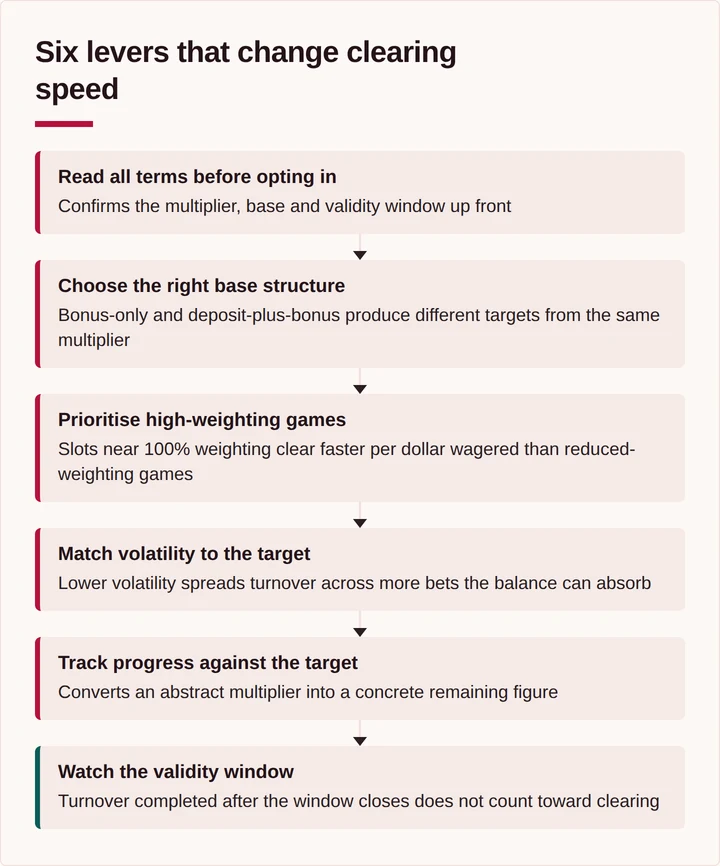
Clearing speed is mostly a function of decisions made before the first bet. The base structure decides the size of the target; the remaining levers decide how fast that target is reached.
Read All Terms Before Opting In
The disclosure standard gives players a structural advantage here. Material conditions must be disclosed at first presentation on the gaming site, with everything else no more than one click away. That means the multiplier, the base it applies to, the game weighting and the validity window should all be reachable quickly. If they are not, that is itself information about the offer. The base figure is the first thing to check, because bonus-only and deposit-plus-bonus structures produce very different targets from the same headline multiplier.
Choose the Right Base Structure
Where a choice exists between offers, the actual turnover target is the comparison that matters. A 30x bonus-only requirement on a $50 bonus is a $1,500 target. A 20x deposit-plus-bonus requirement on a $50 deposit matched by $50 creates a $100 combined base. At 20x, that base produces a $2,000 target. The lower multiplier produces the larger target. Comparing multipliers across different structures is a common arithmetic error in bonus selection.
Prioritise High-Weighting Games
If slots count at or near 100% and table games count at a reduced percentage, clearing on slots is mechanically faster per dollar wagered. This is a statement about how the weighting arithmetic works. For a player who prefers table games, the same target will take longer and cost more in turnover terms.
Match Volatility to the Target
A large turnover target on a high-volatility game carries a real risk of balance exhaustion before the target is reached. A lower-volatility approach spreads the same turnover across more, smaller outcomes, which extends the number of bets a balance can absorb. The target does not change. The probability of surviving long enough to meet it does.
Track Progress Against the Target
Operators often display clearing progress in the account or bonus section. Tracking it converts an abstract multiplier into a concrete remaining figure. It also surfaces the validity window early, so the remaining turnover can be judged against the time left, instead of the deadline being discovered after it has passed.
Watch the Validity Window
Turnover completed after the window closes does not count toward clearing. A requirement that is achievable in a week may be unachievable in 48 hours at the same stake size. The window is a material condition under the disclosure standard and should be visible alongside the multiplier.
Common Player Mistakes
Each mistake below is a reading or arithmetic problem, not a rule violation.
- Comparing multipliers across different base structures, which inverts the actual ranking of the offers.
- Missing the game weighting and clearing on a category that contributes a fraction of each bet.
- Ignoring the validity window until the turnover target is out of reach.
- Overlooking separate wagering terms on free-spin winnings attached to a deposit bonus.
- Assuming a no-wager offer has no conditions at all, when withdrawal caps and other limits may still apply.
- Treating the bonus balance as withdrawable before the turnover target is met.
Building a Simple Strategy
The sequence is arithmetic before it is anything else: identify the base, apply the multiplier, apply the game weighting, check the window against realistic play volume, then select the highest-weighting game category that suits the player and track the remaining figure as play proceeds. Those steps decide whether an offer is worth taking long before the first bet is placed.
Newer operators are not exempt from these terms; new Canadian casino launches show how the same structures appear at recently launched sites.
Conclusion
A wagering requirement is a turnover condition, and its real size depends on the base it applies to and the weighting of the games played. Ontario’s framework adds a regulatory layer. The playthrough-design standard treats excessive playthrough requirements as a failure to facilitate low-risk play, the disclosure standard requires material conditions to be visible at first presentation, and the advertising-restriction standard explains why the real number rarely appears before a player is on the operator’s site. The practical response is arithmetic. Identify the base, apply the weighting, check the window, and compare targets instead of multipliers.
FAQ
What exactly does a 20x wagering requirement mean? It means the player must place bets totalling 20 times the base figure before bonus-derived winnings can be withdrawn. If the base is a $100 bonus, the turnover target is $2,000. The base can also be a $100 deposit plus a $100 bonus. That combination sets the target at $4,000. The multiplier is identical in both cases, which is why the base figure matters as much as the number in front of the x.
Why can’t I see the wagering requirement before I sign up? Ontario’s advertising-restriction standard bars public advertising of gambling inducements, bonuses and credits, covering billboards, broadcast, social and algorithmic ads. Specific bonus terms may only be shown to a player once that player is on the operator’s own gaming site, or through direct marketing to a player who opted in, which Standard 2.07 covers. The disclosure standard then requires the material conditions, including the wagering requirement, to be disclosed at first presentation on the site, with everything else no more than one click away.
Do all games count equally toward clearing a bonus? No. Slots commonly count at or near 100% of each wager toward the turnover target, while table games such as blackjack, roulette and video poker commonly count at a reduced percentage, and some categories are excluded entirely. The weighting is set by the operator and stated in its terms. A reduced weighting effectively multiplies the target, because more real money must be wagered to produce the same counted turnover.
Are no-wager bonuses always better than standard bonuses? They remove the turnover condition, which is the main cost of a standard offer, but they are rare and usually smaller, and they may carry other conditions such as a maximum withdrawal cap. A no-wager bonus with a low cap may release less value than a standard bonus with a modest multiplier that can realistically be cleared. The comparison depends on the cap and the size of the offer, and the absence of the multiplier alone does not settle it.
Does game volatility affect how fast a bonus clears? It does not change the turnover target, which is fixed by the multiplier and the base. It changes how long a balance survives while the player works through that target. High-volatility games swing more per session with rarer but larger wins, while low-volatility games pay more often in smaller amounts. For a large target, a steadier volatility profile extends the number of bets a balance can absorb before the target is reached.
What happens if I don’t meet the requirement before the deadline? Turnover completed after the validity window closes does not count toward clearing, so any remaining requirement becomes unmeetable and the bonus-derived winnings are not released for withdrawal. The window is a material condition under the disclosure standard and should be visible alongside the multiplier. Checking the deadline against realistic play volume before opting in is the simplest way to avoid the situation. For players who want to understand the support side of the framework, responsible-gambling tools overview covers responsible-gambling tools commonly discussed in Canadian online casino contexts.